69 employers
Jobs with pay and contacts
140 routes from Villach to California, filterable by timing, country and visa.
To the tableAnnabell's mission · HTL Villach → space
Software flies on every rocket, satellite and space probe. Here you find 8 careers and the routes in. ESA requires a master's degree for its entry programmes1,2. 5 other routes start right after an Austrian technical school (HTL). Plus 31 addresses from Villach to Darmstadt and 11 missions where code made the difference.
Free, no sign-up, every number linked to its source.
01 · Situation report
Austria has been a full member since 19873,4. For jobs, your citizenship counts1.
Around this many Graduate Trainee opportunities ESA publishes every year1.
This many objects in Earth orbit are regularly tracked by surveillance networks, as of 31 July 20265.
This much data the EU's Copernicus satellites send to Earth every day6.
02 · Apply
69 employers
140 routes from Villach to California, filterable by timing, country and visa.
To the tableCV
International without a photo, Austria with a photo or Europass for ESA. Your data stays in the browser.
Create your CVApplication
For a compulsory internship, speculative application or scholarship, plus all deadlines for 2026/27.
Write a cover letter18 grants
From Erasmus+ via your school to Fulbright, plus visa and registration for each country.
To the scholarships Working abroad03 · Fields
Tap a field to see what is researched there, who works there and which job profile fits. All fields follow the same European standard for space software, ECSS-E-ST-40C; the latest revision has applied since 30 April 202511.
04 · Trajectory
Scroll down the ladder: the rocket shows where you are. ESA grades new staff by years of work experience after the master's degree33. If you love research, you can add a PhD co-funded by ESA after your master's2.
After the final exams and 3 years of professional practice, Austrian HTL graduates can apply for the title “Ingenieurin”34. Already possible now: 4 space projects for students.
Tap a branch: the details are below the ladder.
In Carinthia, for example, Robotics and Artificial Intelligence at the University of Klagenfurt: 6 semesters, taught in English35.
For example Space Sciences and Earth from Space in Graz, 4 semesters, 120 ECTS36. During your master's you can do a 3 to 6-month internship at ESA37.
1 year, extendable by 1 year. Opportunities are published in February and March, start in September or October1.
4 years with the prospect of a permanent post. Up to 3 years of experience, around 15 places per year38.
4 to 14 years of experience after the master's33.
15 or more years of experience after the master's33.
Senior or managerial roles, often advertised at grade A4 only33.
Net monthly salary in Germany (for example at the Darmstadt control centre), first step of each grade, 2026. ESA pays 12 salaries a year, exempt from national income tax in member states; allowances may be added33.
| Grade | Germany | Netherlands | Italy |
|---|---|---|---|
| A1 | €4,977.50 | €4,961.50 | €3,925.39 |
| A2 | €6,358.49 | €6,338.97 | €5,016.27 |
| A3 | €7,846.35 | €7,820.28 | €6,188.95 |
| A4 | €9,116.67 | €9,089.28 | €7,192.74 |
Germany = ESOC Darmstadt, Netherlands = ESTEC Noordwijk, Italy = ESRIN Frascati26. Austria does not currently take part in the National Graduate Trainee programme39.
Bachelor Robotics and AI, 180 ECTS. The university runs Europe's largest indoor drone flight hall35. An algorithm from Klagenfurt is part of the Mars helicopter's navigation story40.
Formerly FH Kärnten. Bachelor Systems Engineering at the Villach campus, 6 semesters; the Green Mechatronics branch combines mechanics, electronics and software41.
Master Space Sciences and Earth from Space. The TU bachelor “Information and Computer Engineering” gives direct admission36.
Master Aerospace Engineering, 120 ECTS, in English. Requirement: at least 30 ECTS in core engineering subjects42.
A degree is the classic route to ESA, but not the only one. These 5 branches start right after school. Each is backed by a job ad, a law or a programme.
Peak Technology in Holzhausen, Upper Austria, is hiring a product engineer for rocket structures and pressure vessels. It asks for an HTL, university of applied sciences or university background and pays €40,000 to €60,000 a year43.
After the HTL final exams and 3 years of professional practice, you can apply for the title “Ingenieurin”34. It sits at level 6 of the Austrian qualifications framework45, equivalent in level to a bachelor's, though not the same kind of degree46.
At SpaceX, SpaceXAI and Cursor, 432 of 546 software ads do not require a degree. Often 2 years of work experience are enough instead47,48,49.
Most ESA roles at grade A ask for a master's. Grade G covers secretarial, administrative and technical support and has different academic requirements51.
At the NASA Space Apps Challenge on 14 and 15 November 2026, teams of up to 6 people tackle one of 14 challenges. Everyone who submits a project receives a participant certificate53.
The branches can merge again later: for some bachelor's programmes, HTL graduates can start in the 2nd or 3rd semester, for example at UAS Technikum Wien46.
05 · Countdown
You do not have to wait for university. In 3 of these projects, your program or your measuring device really runs in space or high in the sky.
In “Mission Space Lab”, your team writes a Python program that collects data on the space station's Raspberry Pi computers. Open to everyone up to 19 in ESA states55.
– days left to register
ESA call ↗A rocket lifts it to at least 700 metres; while falling it measures temperature and air pressure. From age 14, teams of 3 to 6. The winning team goes to ESA in Noordwijk56,26.
CanSat Austria ↗The TU Wien Space Team built a satellite on which school teams run their own Python experiments. 5 HTLs take part, 2 diploma theses are already finished57. It flew to space with Isar Aerospace58,18.
STS1 at TU Wien Space Team ↗Beyond Gravity Austria offers summer internships from June to September, with applications usually in December and January59. ESA Academy offers students training with ESA experts60.
ESA Academy ↗06 · Job profiles
Hover over an image to enlarge it, or tap it. Each profile explains the research, the end product, the tasks and your way in.
End product: the on-board network connecting Orion's systems
Read profile →End product: a mission that delivers data for years
Read profile →End product: manoeuvres that bring probes to their target
Read profile →End product: a rocket that deploys satellites
Read profile →End product: maps and measurements from satellite images
Read profile →End product: open star catalogues for research
Read profile →End product: a magnetic field sensor on board JUICE
Read profile →End product: warnings and avoidance manoeuvres
Read profile →07 · Star map of employers
Tap a dot: the panel shows what happens there with software. The filters show or hide groups. All entries are also listed below.
Schematic map without borders: dots placed by longitude and latitude. Dots in the same city are slightly offset.
Austria's space association Austrospace has more than 30 members61. In Carinthia you find the University of Klagenfurt, the CU Hochschule Kärnten and Silicon Austria Labs.
Research centre for electronic systems in Villach, Graz and Linz. For space, SAL develops laser ignition for rocket engines and, in the SUNRISE project, researches virtual sensors using AI24.
Villach (High Tech Campus), Graz, Linz
Jobs, pay, contacts – Silicon Austria Labs (SAL)Bachelor Systems Engineering, 6 semesters, with the branches Green Electronics and Green Mechatronics; Mechatronics combines mechanics, electronics and software41.
Villach campus
Jobs, pay, contacts – CU Hochschule KärntenBachelor Robotics and Artificial Intelligence and Master Artificial Intelligence and Cybersecurity, both in English35,62. Prof. Stephan Weiss developed an algorithm that lets a camera and a motion sensor navigate a helicopter without GPS40.
Klagenfurt
Jobs, pay, contacts – University of KlagenfurtAround 100 people from 20 nations, involved in more than 20 international missions. The IWF builds space-qualified instruments and analyses the data itself28.
Graz
Jobs, pay, contacts – Space Research Institute (IWF, Austrian Academy of Sciences)Master Space Sciences and Earth from Space, jointly with the University of Graz36. Built the quantum sensor MAGSCA for the Jupiter probe JUICE with the IWF29.
Graz
Jobs, pay, contacts – TU GrazSupplies the TTEthernet network technology for the Orion spacecraft and has worked on Orion's avionics since 200613.
Vienna, Schönbrunner Straße 763
Jobs, pay, contacts – TTTech Computertechnik250 experts in satellite navigation, thermal insulation for more than 800 satellites and launchers, and mechanisms for electric propulsion. Summer internships from June to September59.
Vienna and Berndorf
Jobs, pay, contacts – Beyond Gravity AustriaSoftware for Earth observation, founded in 200864. Known for the almost cloud-free world map made of Sentinel-2 images, combining more than 80 trillion pixels65.
Vienna
Jobs, pay, contacts – EOX IT ServicesBuilt the school satellite STS1, on which school teams run Python experiments57. It flew into orbit with Isar Aerospace on 5 September 202658,18.
Vienna
Jobs, pay, contacts – TU Wien Space TeamImplements Austria's space policy and represents Austria at ESA, the EU and EUMETSAT28.
Vienna27
Jobs, pay, contacts – FFG Aeronautics and Space AgencyBuilds electric propulsion for small satellites; founded in 2016 as a spin-out of the research company of FH Wiener Neustadt28.
Wiener Neustadt
Jobs, pay, contacts – ENPULSIONMaster Aerospace Engineering, 120 ECTS, in English; projects with its research company FOTEC, some funded by ESA42.
Wiener Neustadt
Jobs, pay, contacts – FH Wiener NeustadtMember of Austrospace since November 202561. The group develops radiation-hardened components for satellites66.
Jobs, pay, contacts – Infineon Technologies AustriaDevelops digital technology for several sectors, including space28,27.
Jobs, pay, contacts – Joanneum Research DIGITALOptical and quantum communication in space, from ground stations to software for quantum keys28.
Jobs, pay, contacts – qtlabsOffice of the Director General; decisions on ESA's activities are made here26.
Paris, France
ESA's largest site: test centre and technical management of space projects26.
Noordwijk, Netherlands
Jobs, pay, contacts – ESA ESTECControl centre for satellites in orbit26. Flight dynamics and the Space Debris Office also work here15,30.
Darmstadt, Germany
Jobs, pay, contacts – ESA ESOCEarth observation archives and more than 20 ground stations26. The Φ-lab researches AI for Earth observation23.
Frascati near Rome, Italy
Jobs, pay, contacts – ESA ESRIN and Φ-labScience operations centres and archives for astronomy and planetary missions26.
Villanueva de la Cañada, Spain
Jobs, pay, contacts – ESA ESACTraining facility and home base of all European astronauts26.
Cologne, Germany
Jobs, pay, contacts – ESA Astronautenzentrum EACTelecommunications, applications, climate change, technology and science26.
Harwell, United Kingdom
Jobs, pay, contacts – ESA ECSATSpace cybersecurity, control of the Proba satellites and a space weather data centre26.
Redu, Belgium
Jobs, pay, contacts – ESA ESEC96,000 hectares near the equator, from where Europe's rockets launch26.
Operates Europe's weather satellites; 30 member states, including Austria67.
Darmstadt, Germany
Jobs, pay, contacts – EUMETSATDepartments for flight software, intelligent and distributed systems, digital twins and high-performance computing12.
including Cologne, Braunschweig, Oberpfaffenhofen, Berlin, Bremen
Jobs, pay, contacts – DLR Institute of Software TechnologyOn the Hera avionics bench at OHB, the most complex navigation test ever performed for an ESA spacecraft took place68.
Bremen, Germany
Jobs, pay, contacts – OHBMore than 400 employees at 5 locations. On 5 September 2026 its Spectrum rocket became the first from a commercial European company to put satellites into orbit18.
near Munich, Germany
Jobs, pay, contacts – Isar AerospaceA GMV team developed the autonomous navigation of the asteroid probe Hera69.
Jobs, pay, contacts – GMVDeveloped the open flight software F Prime that ran the Mars helicopter Ingenuity10.
Jobs, pay, contacts – NASA Jet Propulsion LaboratoryLands rocket stages: the on-board computer computes the landing trajectory with optimisation software on board17.
Jobs, pay, contacts – SpaceX08 · Top missions
Open a mission to see what happened, which software was behind it and what you can take away. Images enlarge when you hover or tap.
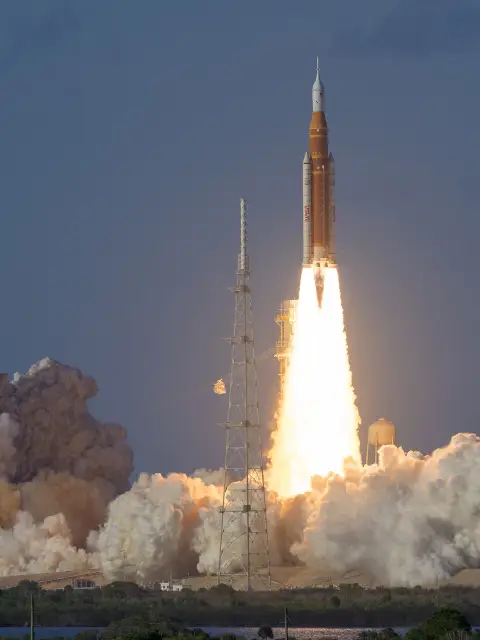
Record: farther from Earth than any human before.
On 1 April 2026, Artemis II launched with Reid Wiseman, Victor Glover, Christina Koch and Jeremy Hansen. On 6 April 2026 the crew flew around the Moon, and on 10 April 2026 it splashed down in the Pacific70. The mission lasted 9 days, 1 hour and 32 minutes71.
At the farthest point the 4 were 252,756 miles (about 406,770 kilometres) from Earth, a new record for humans70.
Inside the Orion spacecraft, TTEthernet by TTTech from Vienna connects all control and life-support systems, like a nervous system13.
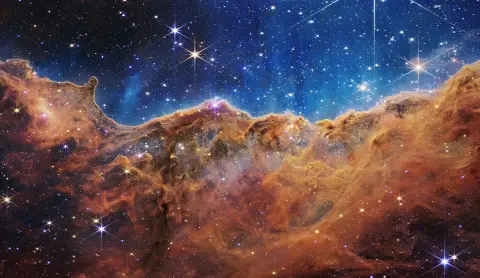
The largest space telescope runs its observations with scripts.
Webb does not work through a rigid list of commands. On-board scripts written in JavaScript build the commands themselves and check the telemetry to see whether each command has been completed72.
This lets the telescope react when an observation takes longer than planned, without waiting for the ground station72.
A language you know from web development runs one of the most expensive instruments humanity has built.
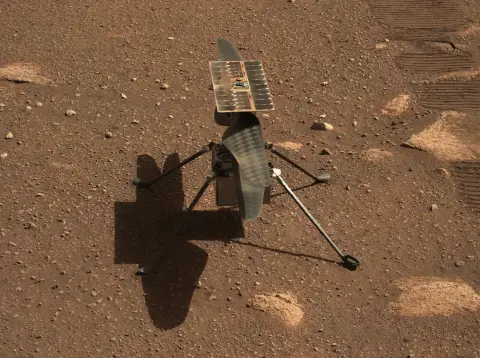
A phone chip, open software and an algorithm from Klagenfurt.
The plan was no more than 5 test flights in 30 days. Ingenuity flew 72 times, from 19 April 2021 to 18 January 2024: 128.8 minutes and 17 kilometres9.
On board ran JPL's open flight software F Prime10, and the computing was done by a Snapdragon 801 chip from the phone world73.
Stephan Weiss, professor at the University of Klagenfurt since 2015, developed an algorithm that lets a camera and a motion sensor navigate without GPS. It was intended for the Mars helicopter40.
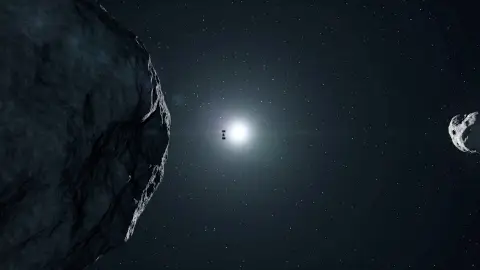
It recognises boulders and craters to find its way.
Hera launched on 7 October 2024 and reaches the binary asteroid Didymos in November 2026, 1 month earlier than planned68.
Its navigation tracks boulders and craters in successive images and derives its own altitude and trajectory. It was developed by a GMV team in Spain and Romania and tested during the Mars flyby on 12 March 202569.
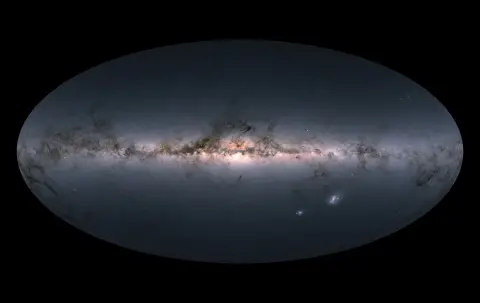
The next catalogue comes out on 2 December 2026.
Gaia collected more than 3 trillion observations of about 2 billion stars and other objects. Science observations ended on 15 January 2025, and the spacecraft was switched off on 27 March 202574.
The DR4 catalogue contains about 2.8 billion sources from 66 months of data and roughly 400 terabytes7. It is released on 2 December 20268.
The spacecraft is switched off, but the work goes on: software keeps turning raw data into new catalogues for years.
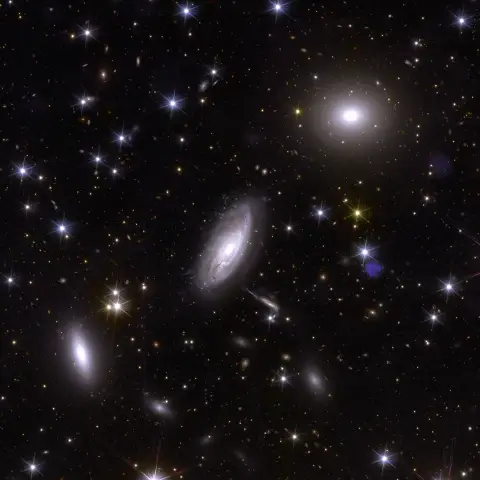
26 million galaxies in 1 week of observations.
In 1 week, Euclid found 26 million galaxies. The AI model Zoobot, trained by 9,976 volunteers, sorted more than 380,000 of them by shape; AI and people together found 500 candidates for strong gravitational lenses25.
Euclid sends around 100 gigabytes a day and will image more than 1.5 billion galaxies over 6 years. The major data release is planned for October 202625.
Behind Euclid are more than 2,000 scientists from 300 institutes25. Many of them write code every day.
Detecting clouds before data goes to Earth.
Φ-sat-1 launched on a Vega rocket on 3 September 2020. It was the first experiment in which a neural network on board analyses images: it computes which parts of an image are covered by clouds20,21.
That way the satellite, about the size of a shoebox, sends only usable images to Earth22.
The animation shows the principle: detect clouds, mark them, remove them. The satellite image shows Lake Wörthersee; the clouds are drawn.
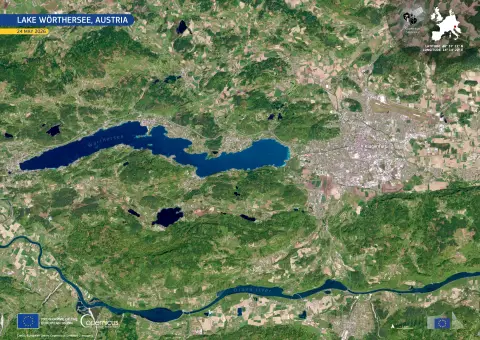 Diagram: cloud mask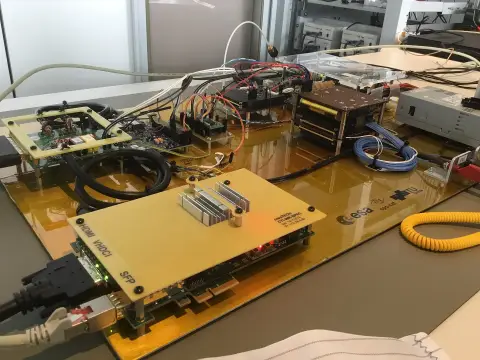
The first satellite open to use by the public.
OPS-SAT flew from 18 December 2019 to May 2024. 134 teams from 26 countries ran more than 284 experiments, including AI on board75.
Firsts: the first satellite open to use by the public, and the first demonstrated cyber attack in orbit. Some of its software is now used by much larger missions75.
In 2023 the team shared a SpaceOps award with the team of the Mars helicopter Ingenuity75.
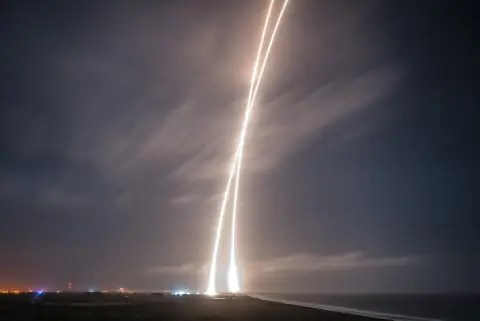
Optimisation on board instead of a fixed trajectory.
A landing first stage must find a trajectory that ends at rest and upright on the target, without exceeding what the hardware can do17.
SpaceX uses the tool CVXGEN: it generates custom flight code that solves this optimisation very quickly on board17.
The dashed line is the planned path. Highly simplified, not to scale.
The most famous software failure in spaceflight.
On 4 June 1996, about 36.7 seconds after launch, both inertial reference systems of the new Ariane 5 stopped working; shortly afterwards the rocket broke up76.
The cause: in Ada code, a 64-bit floating-point number was converted to a 16-bit integer. The value was too large because Ariane 5 builds up horizontal speed faster than Ariane 4. The function came from Ariane 4 and served no purpose after lift-off76.
The inquiry board recommended, among other things, deliberately overlapping tests at equipment, stage and system level77.
-- simplified example, not the original code
declare
   BH     : Long_Float := 50_000.0;  -- 64 bit
   BH_int : Integer_16;              -- max. 32,767
begin
   BH_int := Integer_16 (BH);       -- Operand Error!
end;
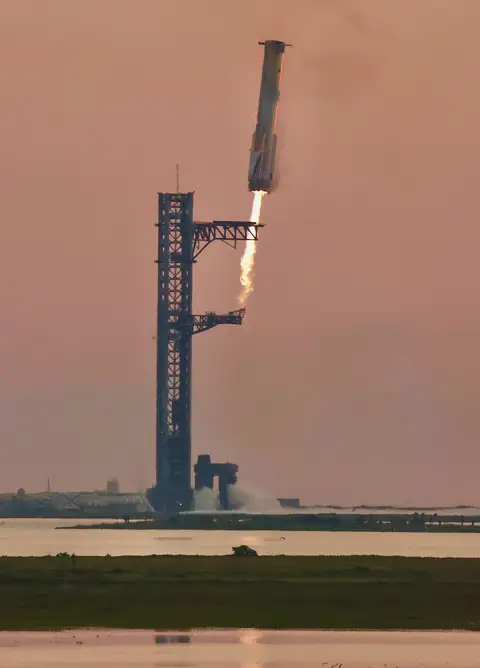
New: its own page with history, sites and matching jobs.
On 28 September 2026 Starship reached orbit for the first time on its 14th test flight and deployed 26 Starlink satellites78. Since February 2026 the Grok AI has also been part of SpaceX79,80.
Together with SpaceXAI and Cursor, SpaceX advertises 3,016 positions, from Texas to Dublin and London47,48,49.
8 software jobs that match your school focus, with locations and your way there.
09 · Questions
For the entry programmes, yes: Graduate Trainee, National Graduate Trainee and Junior Professional all require a master's2. Internships are possible during your studies, ideally in the final or second-to-last year of a master's37.
Yes. Austria has been a full ESA member since 19874. For the programmes, citizenship of a member state is what counts1.
At grade A1 in Germany €4,977.50 net per month, 12 times a year, as of 2026. The salary is exempt from national income tax in member states; allowances may be added33.
You meet Python in school experiments on STS1 and the ISS57,55 and in the space debris library Kessler32. JavaScript runs scripts on board Webb72, and the Ariane 5 code of 1996 was written in Ada76.
Until 22 February 2027 you can register for Astro Pi; your Python program then runs on the ISS55. There is also the CanSat competition56 and diploma theses around the school satellite STS157.
Yes. Silicon Austria Labs in Villach researches AI sensing for rocket engines24. The University of Klagenfurt teaches robotics and AI35, and the CU Hochschule Kärnten in Villach teaches systems engineering41.
A growing one: in 2020 Φ-sat-1 was the first to detect clouds with AI on board20. Euclid sorts galaxies with the AI model Zoobot25, and ESA's Φ-lab researches AI for Earth observation23.
In Paris, Noordwijk, Darmstadt, Frascati, near Madrid, in Cologne, Harwell and Redu, plus the spaceport in French Guiana26.
Every small number leads to its source with publisher, date and link. Company statements about themselves are marked. As of 27 September 2026.