Austria
51 % expect net job losses
51 per cent expect AI to destroy more jobs than it creates. But only 20 per cent fear for their own job — and 46 per cent would be willing to retrain to keep up. Is
Ipsos Austria, AI survey 2026.
As of 27 July 2026 · Sources: Pew, Ipsos, Bitkom, Deloitte, ifo · every figure with its source
Around the world, more people are concerned than excited about artificial intelligence: 50 per cent in the USA, and in Germany only 11 per cent meet it with no worries at all. The reasons are concrete — misinformation, lack of control, unsafe data, fear for their jobs. Teddynews builds AI applications that take exactly these concerns seriously: European, transparent, and built to strengthen work rather than replace it.

Every figure on this page is in the open HTML and carries its source — you can check the maths before your first click. No account, no newsletter, no tracking.
How the world views AI
In most countries concern prevails. In the USA, 50 per cent are more concerned than excited, only 10 per cent the other way round — in 2021 it was just 37 per cent. Worldwide, nervousness (53 per cent) and excitement (52 per cent) are neck and neck. In Germany it is almost level — but the share who see more benefits than drawbacks in AI products fell from 49 to 37 per cent within a single year.
This is the share who feel “more concerned than excited” about AI in daily life. In the USA it rose from 37 per cent (2021) to 50 per cent (2025). For comparison, the “excited” values: USA just 10 per cent, worldwide median 16 per cent.
In Germany it is almost level — but the excitement is fading: only 37 per cent now see more benefits than drawbacks in AI products, a year earlier it was 49 per cent (minus 12 percentage points). And only 48 per cent trust AI companies to keep their data safe.
Is · Pew Research Center, global AI survey 2025 (25 countries) · Ipsos AI Monitor 2025 (30 countries, over 23,000 respondents) and Ipsos AI Monitor Germany.
The reasons, with figures
People in Germany who have reservations rarely mean the capability. The biggest concerns are misinformation and too little control (50 per cent each), AI gaining too much power (49 per cent), unsafe data (43 per cent) and opacity (42 per cent). These are not doubts about the technology, they are questions of trust — and how something is built can address exactly those questions.
Only 11 per cent meet AI with no worries at all — twice as many as the year before (5 per cent), but still a small minority. Notably: five of the seven concerns are questions of trust and control, not of capability.
Is · Bitkom, “Artificial Intelligence in Germany”, 2026 report, representative survey of 1,005 people aged 16 and over.
Job fears in Germany, Austria, Switzerland and the USA
Across the German-speaking region, around half expect AI to destroy more jobs than it creates. The fear for one's own job is usually smaller than the general expectation — but it decides whether people use AI at all. Trust grows where people use AI deliberately and with guidance — as a tool the human leads, not as a replacement.
Austria
51 per cent expect AI to destroy more jobs than it creates. But only 20 per cent fear for their own job — and 46 per cent would be willing to retrain to keep up. Is
Ipsos Austria, AI survey 2026.
Switzerland
Almost one in two employees fears losing their job — even though 61 per cent already use AI at work. At the same time, a third see no use in AI for themselves. Is
Deloitte Switzerland, AI study (survey 2025).
Germany
34 per cent fear losing their job to AI. The ifo Institute adds, from the employer side: 27 per cent of firms expect AI to make positions redundant within five years. Is
YouGov Germany · ifo Institute, business survey.
USA
US workers are “more worried than hopeful” about AI in the workplace — in line with the 50 per cent who are more concerned than excited about AI in general. Is
Pew Research Center, survey of US workers, February 2025.
The figures paint a more sober picture: across the whole economy, job loss is barely measurable so far — the pressure sits mainly at the point of entry into working life. The evidence is openly laid out on the page AI as a tool. And that is exactly where tools that build skills rather than replace them help.
Is · Ipsos Austria 2026 · Deloitte Switzerland 2025 · YouGov Germany · ifo Institute · Pew Research Center 2025.
What Teddynews does differently
A safe harbour does not talk the concerns down — it takes them as its benchmark. Four principles carry it: European (data and law in the EU), transparent (the use of AI is disclosed and stays checkable), the human decides (AI proposes, you approve) and work-strengthening (tools build skills instead of replacing positions).
Concern: misinformation & wrong results (50 / 41 %)
Our applications work with traceable sources and human review. The data pages here show what that looks like: every figure with its source, counter-evidence explicitly included.
Concern: too little control & too much power (~50 % each)
No corporate black-box model, but small, clearly defined tools — from a European provider, GDPR-compliant and within the EU AI Act. Control stays with you.
Concern: unsafe data (only 48 % trust)
The web apps are hosted 100 per cent in Europe — no third-party tracking, no profiling. Consistent down to the detail: we even host the fonts ourselves.
Concern: opacity (42 %)
Wherever AI is involved, it is disclosed, as the EU AI Act requires. The result stays checkable and the decision stays with you — no automatic hand-over.
Concern: job loss (Germany, Austria, Switzerland ~50 %)
Our tools produce proposals — the human checks, edits and approves. AI takes on the routine, not the responsibility. The role shifts instead of disappearing.
Concern: loss of skills (29 %)
The AI courses make people AI-capable rather than AI-dependent — including proof of competence under Article 4 of the EU AI Act, which has required exactly that since February 2025.
The principles apply to every Teddynews product. Evidence on data protection, EU hosting and AI disclosure: AI as a tool — why location matters.
From principle to product
The safe harbour is not a statement of intent — these tools are already running. Each of these tools takes one concrete concern seriously: it builds capability, keeps the human at the wheel and saves time without taking over the decision.
First understand · ai.teddynews.at
Capability instead of dependence. Make yourself and your team AI-capable — with EU AI Act proof of competence. From 79 euros, one-off, lifetime access.
Create, you decide · lander.teddynews.at
AI builds a complete landing page from keywords — you check, edit and approve. One-off payment of 199 euros, no subscription.

Win back time · teddybuzz.com
Takes over the daily social-media routine — approval stays with you. GDPR-compliant on EU servers. From 9 euros a month, seven days free.
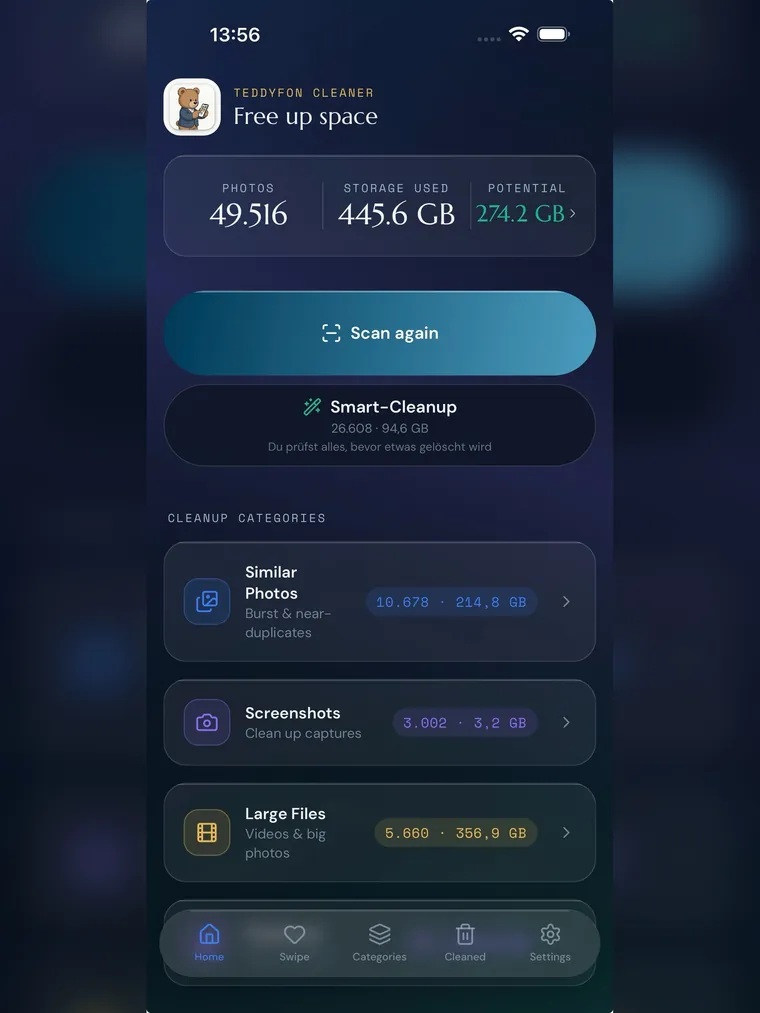
Free up space · App Store
Frees up storage on your iPhone without collecting data — a tool that helps and then steps back. Offer: 1.99 euros.
Who is behind this

A safe harbour does not come from marketing, it comes from experience with both sides: what tools take off your plate — and where they fail. That is exactly why, on this page, the concern stands right next to the answer.
Personal contact and intermediary: Wolfgang Lindner, Teddynews, Austria. Client for the products: YiYaBao Inc. We sell AI courses and AI software — which is why every figure carries its source, and we name the counter-evidence too.
An answer from a person, not from a ticket system. No sales call as a precondition for information.
Frequently asked
Partly yes. Around the world more people are concerned than excited — 50 per cent in the USA, and in Germany only 11 per cent meet AI with no worries at all. The most common reasons — misinformation (50 per cent), lack of control (50 per cent), unsafe data (43 per cent) — are real risks. It becomes unjustified where people claim across the board that “AI can't do anything”: within its limits the benefit is measurable. The honest answer is not reassurance, but how it is built.
Four things: European hosting and European law, disclosure of the use of AI, checkable results with human approval, and a purpose that strengthens work instead of replacing it. If one of these is missing, it is not a safe harbour — however good the model is.
Across the whole economy it is barely measurable so far; the pressure sits mainly at the entry into working life. In the German-speaking region around half expect net job losses (Austria 51 per cent), while far fewer fear for their own job (Austria 20 per cent, Germany 34 per cent). Tools the human leads shift the role — they do not replace it.
Onto EU servers, without third-party tracking and without profiling. For content that works without it, there is no sign-up requirement. That answers the very thing only 48 per cent trust AI companies with: the protection of their own data.
This page sells AI courses and AI software — which is why every figure carries its source, and we name the counter-evidence too. Showing only one side talks past the facts and loses credibility at the first counter-example. All figures come from Pew, Ipsos, Bitkom, Deloitte, YouGov and the ifo Institute.
If you want to understand where AI helps and where it slows you down: the page “AI as a tool”. If you want to become AI-capable yourself — with EU proof of competence: the AI courses. Both without a subscription and without a sales call.