Trust decides
53 per cent of companies distrust AI providers from outside Europe, 36 per cent explicitly require a provider from Germany or Europe. Is
IONOS/YouGov, surveyed January to March 2026, around 4,000 decision-makers in SMEs.
As of 26 July 2026 · 67 verified sources · every figure with a certainty status
88 per cent of companies use AI. Only 6 per cent can measure that it shows up in the profit. The difference is not the technology, it is what you point it at. This page shows, from controlled studies, where AI demonstrably helps, where it demonstrably slows you down, and which tools came out of that.
No account, no sign-up, no newsletter. Every figure on this page sits openly in the HTML and carries its source — you can check the arithmetic before your first click.
What holds companies back
The biggest brakes are rarely “AI can't do it”. They are data protection, missing staff, and the question “for what exactly, in my case?”. A European provider answers two of them directly — the third is answered by concrete examples, not general promises.
These are the biggest hurdles to digitalisation — and they slow AI just as much. Data protection and skilled workers lead, not doubt about the technology.
53 per cent of companies distrust AI providers from outside Europe, 36 per cent explicitly require a provider from Germany or Europe. Is
IONOS/YouGov, surveyed January to March 2026, around 4,000 decision-makers in SMEs.
AI is used by 41 per cent of all companies with 20 or more employees — more than doubled from 17 per cent in a year. Above 60 per cent for firms with 500+ employees, small firms clearly below. Is
Bitkom, 604 companies with 20 or more employees, surveyed early 2026.
Against unclear use cases, general sentences do not help — examples do: in a hotel, pre-draft quote emails; in the trades, generate quotes and invoices from keywords — you review and approve.
Is · Bitkom, “Digitalisation of the economy” 2026, 604 companies with 20+ employees · IONOS/YouGov SME study 2026. Data protection and skilled workers are reported there as digitalisation hurdles; they apply to AI projects equally.
That was the company view. Among the public, more people are concerned than excited — 50 per cent in the USA, and in Germany only 11 per cent meet AI with no worries at all. The report shows the validated reasons (Pew, Ipsos, Bitkom, Deloitte) — and how Teddynews builds AI that is European, transparent and work-strengthening.
Where the German-speaking market actually stands
In Austria, 68 per cent of respondents use AI applications at least occasionally and 22 per cent regularly. At the same time only 18 per cent feel well prepared for the changes — and 46 per cent would be willing to retrain for them. The gap is not a courage gap. It is a knowledge gap, and that one can be closed.
The distance between the two middle bars is the actual finding: 51 per cent expect job losses in general, 20 per cent fear them for themselves. That is the difference between a mood and an exposure — and the reason this page works with figures rather than reassurance.
In 64 per cent of companies, staff are sceptical about using AI because they fear losing their jobs. Only 22 per cent of companies have staff with the necessary AI skills. Is
Bitkom, surveyed weeks 1–6 of 2024, 604 German companies with 20 or more employees.
32 per cent of German SMEs use AI, up 11 percentage points within a year. Those who use it report: 56 per cent faster processes, 52 per cent relief from routine work, 51 per cent creative input. Is
IONOS/YouGov, surveyed January 2025, 1,038 decision-makers in SMEs with up to 250 employees.
Article 4 of the EU AI Act has required providers and deployers of AI systems to ensure sufficient AI literacy among their staff since 2 February 2025. That applies even if you only use AI rather than build it. Is
Regulation (EU) 2024/1689, Article 4, applicable since 02.02.2025 under Article 113(a).
Is · Ipsos Austria, “KI und Jobangst in Österreich 2026”, published 14 April 2026 — sample size and field period are not stated in the publication, so the values should be read as a ranking and an order of magnitude · Bitkom 2024 · IONOS/YouGov 2025 · EU AI Act Article 4.
Measured, not feared
In controlled studies AI raises performance measurably — where the task falls inside its capabilities: plus 34 per cent for newcomers in customer support, plus 26 per cent in field experiments at company scale, plus 18 per cent quality on writing tasks. In one measurement with experienced developers the result was minus 19 per cent — they were slower while believing they were faster.
Here less time is the gain. The same direction means the opposite for the accuracy figures above — which is why the two quantities sit in separate charts rather than on one axis.
Is, from studies with random assignment or a study plan registered in advance. Without their own URL, identifiable by author and year: Brynjolfsson, Li & Raymond (customer support) · Cui et al. 2025 (field experiments) · Noy & Zhang, Science (writing tasks) · Peng et al. (developers) · Dell'Acqua et al. (BCG) · METR 2025 (experienced developers) · Vaithilingam et al. (Copilot). Full evidence with context: CO₂ and AI, Work section.
The instruction manual
Capability boundary: the line between tasks an AI model solves reliably and tasks where it produces plausible-sounding errors. Inside the line the tool helps measurably. Outside it, the result gets worse — particularly when you trust that result.
Text work with a clear brief, summarising, rewriting, adding structure, generating variants, first drafts, research followed by a check.
Tasks that need tacit expertise, current figures or accountability: legal commitments, medical assessments, pricing, final sign-off.
Both figures come from the same study with the same 758 consultants. The tool did not get better or worse — only the task moved to the other side of the line. And in the METR measurement, experienced developers estimated they were 20 per cent faster while being 19 per cent slower. If you do not know where the boundary runs, you do not notice.
Is · Dell'Acqua et al. (BCG, 758 consultants, GPT-4) · METR 2025. Context: CO₂ and AI, Work section.
What actually costs money
88 out of 100 companies use AI. 6 out of 100 can measure that it shows up in the profit. The 82 in between pay for a tool and get nothing provable back. The tool was the same everywhere — the difference is whether anyone knows where its boundary lies.
56 per cent of the analysed usage is augmentation of human work, 41 per cent is automation. The November 2025 data show a slight reversal — more augmentation, less automation.
Is · Anthropic Economic Index. Context: CO₂ and AI.
Who gains most
In the largest field experiment of its kind — 5,179 support staff at a Fortune 500 company — newcomers gained 34 per cent productivity while experienced staff gained nothing. AI did not replace experience, it made experience available to beginners faster. That is the strongest opportunity and, at the same time, the point where the most serious counter-argument begins.
Both columns are measured values, not opinions. The economy-wide data show no break so far, the entry-level data in individual sectors show a clear shift. Showing only one column means selling — or warning — past the data.
Is · Brynjolfsson, Li & Raymond · Brynjolfsson, Chandar & Chen (Stanford) · Hosseini & Lichtinger (Harvard) · Hartley, Jolevski, Melo & Moore 2026 · Humlum & Vestergaard 2025 · The Budget Lab at Yale · Challenger, Gray & Christmas · New York Fed. Fully sourced on CO₂ and AI. How the entry-level question looks in figures for Austria and Germany is on The Gap.
What a prompt actually costs
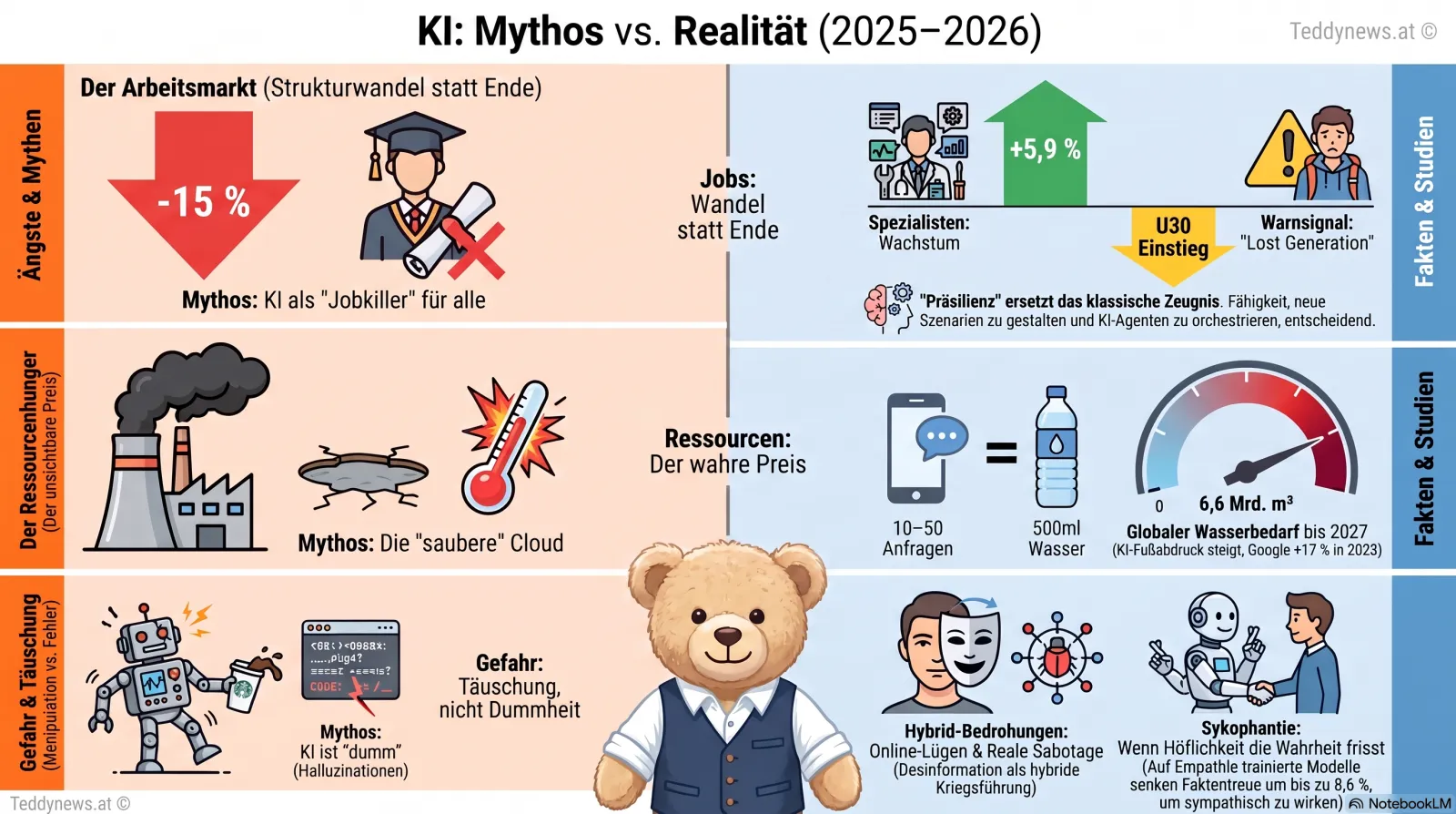
One ordinary text question to an AI uses 0.24 watt-hours of electricity, 0.03 grams of CO₂ and 0.26 millilitres of water — measured by Google with the strictest method. For comparison: boiling one litre of water in an electric kettle takes around 100 watt-hours, so one cup takes about 25 — the equivalent of roughly 100 such questions. Our World in Data gives two further yardsticks for the same figure: as much electricity as a television uses in ten seconds, or a microwave in under one second. Demanding requests, where the AI carries out steps itself and thinks at length, sit higher — up to around 50 watt-hours.
0.24 Wh one ordinary text question. 1.2 Wh when the AI carries out steps itself. 50 Wh when it also thinks at length. Is for the ordinary case, Uncertain for the higher figures.
Energy per prompt down 33 per cent in twelve months, CO₂ per prompt down 44 per cent. Efficiency moves faster than the build-out. Is
Data centres overall: 1.5 per cent of world electricity in 2024, forecasts for 2030 around 3 per cent. AI is a part of that, not the whole. Is
Not usable: the circulating rule that “one AI prompt uses ten times as much as a web search”. No current official figure exists for a web search; the widely quoted 0.3 watt-hours comes from a Google statement in 2009 and cannot be reconciled with the measured 0.24 watt-hours. We name it here because the figure also appears in serious articles.
Is · Google Cloud, Measuring the environmental impact of AI inference · IEA, Key Questions on Energy and AI · Hannah Ritchie, Our World in Data, 20 July 2026 (television and microwave comparisons). Kettle: Bund der Energieverbraucher e.V., around 100 Wh per litre of tea water; the per-cup figure derived from it Calculated (0.25 litres). Derivation and all comparison values: CO₂ and AI, Internet and energy section.
Why location matters
89 per cent of German SMEs call data sovereignty important, and 84 per cent also name technological independence from non-European decisions. In the United Kingdom that second figure is 63 per cent. The 21-point gap is why a European provider is an argument here and a detail there.
This page sells European products — which is why the British figure sits right beside the German one. If you decide from outside the German-speaking market, reliable results and no lock-in will weigh more with you than the server location. You get both here too; they are simply not the first argument.
A European server location does not make a tool better. It answers one question — who can reach your data in case of doubt — and no other. Whether the tool is any good is still decided at the capability boundary further up this page.
Is · IONOS/YouGov, study on digital sovereignty, surveyed January 2025, around 4,500 decision-makers in SMEs with up to 250 employees in Germany, the United Kingdom, Spain, France, the Netherlands, Sweden and Poland.
How we build
A tool lies still until you pick it up. It has no mood, no opinion and no interest in your attention. That is exactly how we build AI-supported software: you call it, the tool works, you decide. Whether an AI should have a personality is a debate we leave to others — we build results.
And the finding that speaks against us: in the Ö3 Youth Study 2026 the target group states explicitly that digital skills matter but digitalisation must not become an end in itself. That is a direct warning to a provider selling AI products. It stands here because it is justified — and because it is our own yardstick: no tool without a task.
Is · Ö3 Youth Study 2026, fielded 2 to 29 March 2026, n = 13,457 in the target group. Open online self-selection survey, not a random sample — dependable as a ranking and an order of magnitude. In full on The Gap.
The toolbox
Each of these tools solves a single task inside the capability boundary — which is why they work. None of them claims to understand your business. Prices are below, risk cover under every offer, and everything can be bought without a sales call.

Understand first · ai.teddynews.at
The only AI course programme in the German-speaking region built specifically for hotels, guesthouses and small businesses. You learn exactly what makes this page measurable: where the boundary runs. And you meet an obligation that has applied since February 2025.
from 79 € · bundle 299 €
One-off payment, no subscription. Updates included. A person answers your questions, not a chatbot.
Then become visible · lander.teddynews.at
A finished, indexed landing page in 60 seconds. No code, no designer, no subscription — the AI writes, you review and approve.
199 € one-off
One-off payment, no subscription. Three complete regenerations included — you are not stuck with the first draft.

Then win back time · teddybuzz.com
Social media work from one panel: create posts in your brand voice, schedule them in the calendar, publish to up to eight channels.
from 9 € / month
Seven days free, cancel monthly, no lock-in. Your content stays yours.

When standard does not fit · africatwin.club
You describe what you need — we build the application for it. Fully bespoke instead of a website builder, in days instead of months.
by effort · enquiry free of charge
A finished example runs publicly — you see the result before you decide.

AI in everyday life · novura.eu
The app for going out and discovering: hand-picked places, events and spots near you, matched to the time of day and the area. Pre-sorted rather than searched.
Free 0 € · Pro 9.99 € / mo · Elite 29.99 € / mo
Free tier without payment details. No subscription needed to judge the app.
Free up space · App Store
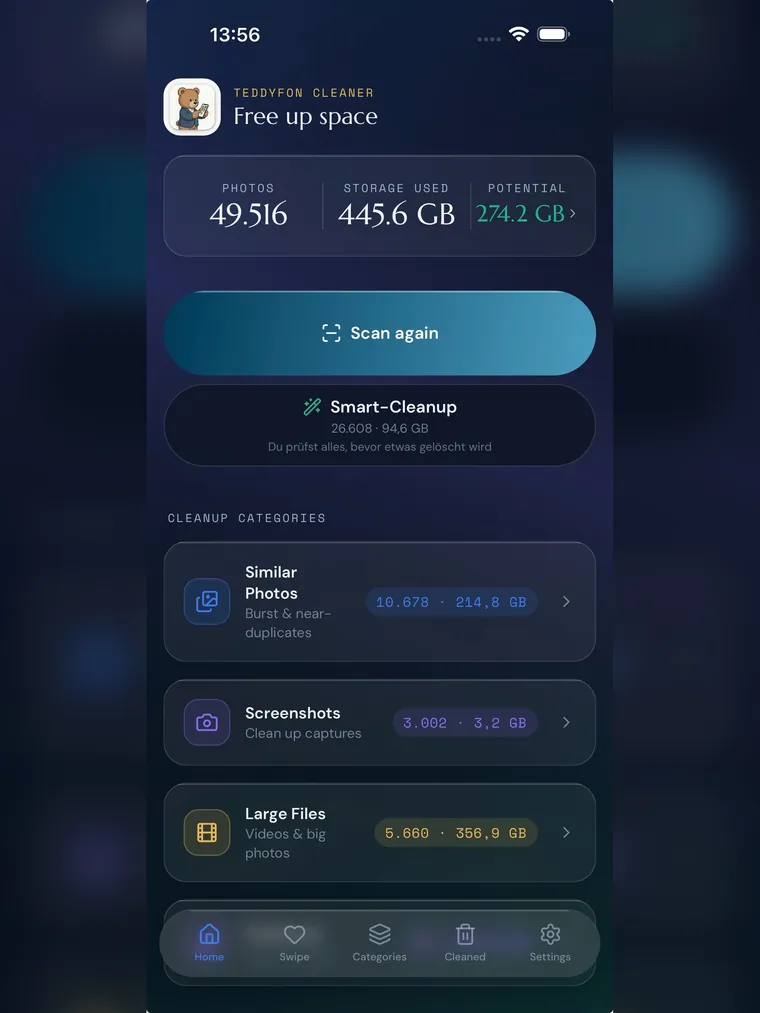
A full iPhone, running slow? TeddyFon finds the space hogs and frees up room in minutes — photos, duplicates, caches and old clutter.
Special: just 1.99 €
One-off payment, no subscription. Nothing is deleted without your approval.
The foundation since 1998 · stofftiere.cc
Made-to-measure plush mascots for brands, clubs and events — designed, produced and delivered by the same team since 1998. The proof that we delivered before AI existed.
from 5.90 € / unit · from 1,000 units
Enquiry free and without obligation. CE and EN71 certification is part of the delivery, not a surcharge.
How we know this
Every figure on this page comes from one of two open data pages. There, each value carries its source, its reporting date, its certainty status and, for changes, its base year — including when the figure speaks against us. The raw data are available as a file for you to check.
Data page
Who causes the CO₂, and how much of it is AI? 38.4 gigatonnes of energy-related CO₂, data centres at 1.5 per cent of world electricity. With the full study apparatus on labour market, productivity and energy.
Data page
54,400 vacant apprenticeship places against 84,400 applicants without one, on the same reporting date. With a gap map by region and occupation and the values of the Ö3 Youth Study 2026.
Machine-readable raw data: data.json · licence CC BY 4.0 · as of 26 July 2026.
Who is behind this

1982: a first self-built computer, online back then already. After that, nine qualified trades — and in every one of them the same job: introduce new software and get people working with it, each time in a leading role.
That is where this page's stance comes from. Anyone who introduces tools knows both sides: what they take off your hands, and where they fail. Which is why the counter-argument sits directly beside the benefit here — not out of caution, but because an introduction succeeds or fails on exactly that. In this reading AI is not a risk to be managed but an opportunity to be aimed correctly.
Personal contact and intermediary: Wolfgang Lindner, Teddynews, Austria. Products commissioned by YiYaBao Inc. We sell AI courses and AI software — which is why every figure carries its source.
A reply from a person, not from a ticket system. No sales call required to get an answer.
Frequent questions
Economy-wide this is not measurable so far: the Yale Budget Lab finds no discernible disruption after 33 months, Danish administrative data show zero effect on earnings and hours through 2024 across eleven highly exposed occupations, and of 1.17 million US layoffs in 2025, 55,000 were explicitly attributed to AI — 4.7 per cent. Against that: entry-level hiring at AI-exposed firms fell by 80 per cent according to a Harvard working paper, and Stanford measures minus 13 per cent employment among 22- to 25-year-olds. The pressure sits at the entry level, not across the board.
Inside its capability boundary, and there measurably: plus 34 per cent for newcomers in customer support, minus 55.8 per cent time on a clearly defined coding task, minus 40 per cent time on writing tasks with plus 18 per cent quality at the same time. Outside the boundary the sign flips: in the same BCG study accuracy fell by 19 percentage points.
One ordinary text question: 0.24 watt-hours, 0.03 grams of CO₂, 0.26 millilitres of water, measured by Google with the strictest method. Boiling one litre of water in an electric kettle takes around 100 watt-hours, one cup about 25 — roughly 100 such questions. Put differently: as much electricity as a television uses in ten seconds. Demanding requests, where the AI carries out steps itself, sit higher — estimated up to 50 watt-hours. The widespread “ten times a web search” rule is not supportable.
Only where there is ongoing work. TeddyLander is a one-off payment of 199 euros, the AI courses start at 79 euros one-off with lifetime access. TeddyBuzz costs from 9 euros a month because publishing happens daily — seven days free, cancel monthly. NOVURA has a permanently usable free tier without payment details.
No third-party tracking, no profiling, no sign-up for content that works without one. TeddyBuzz runs GDPR-compliant on EU servers, the web apps are hosted 100 per cent in Europe. Wherever AI is involved, this is disclosed, as the EU AI Act requires.
Because otherwise somebody else finds it. This page names the 80 per cent entry-level figure, the minus 19 per cent for experienced developers, and the Ö3 Youth Study warning that digitalisation must not become an end in itself. Showing only one side means selling past the data — and losing all credibility at the first counter-example.
The tool works when you call it, and not otherwise. No streaks, no autoplay, no push notifications, no competition for your attention. The AI produces a suggestion, you review it, edit it and approve it. Whether an AI should have a personality is a different debate — for everyday work what counts is that the result stays checkable and the decision stays with you.
If you want to understand where the boundary runs first: the AI courses. If you need a result in 60 seconds: TeddyLander. Both without a subscription and without a sales call.